About Me

My photo
Murlough is cared for as Ireland's first nature reserve since 1967, the fragile 6000 year old sand dune system offers some lovely walks. Due to the reserves wild nature you can discover birds, flowers, butterflies and more, all overlooked by the rounded peaks of the Mourne Mountains to the south.

Tuesday, 17 November 2015

Firewood Processing


The Set Up

Old faithful, she keeps us warm and dry
Here at Murlough Stableyard, we own a log gasification burner which provides hot water and spacial heating to the offices, the workshops and the volunteer accommodation.The set up consists of a incinerator complete with a downdraft system, which directs gasified wood and smoke into a secondary burn chamber. Here, the gases are ignited, virtually eliminating smoke when running at full tilt.

All of this thermal energy is transferred to a surrounding water jacket which heats up counter-flowing water, which then flows to a nearby tank. The connected water tank is encased within a thick layer of insulating foam to minimise the heat loss. It is this store of heated water that us volunteers so heavily depend upon during the bone-chilling evenings.

From Felled Timber to Seasoned Firewood       The video

 It all sounds complicated but it is essentially a very efficient water heater. Grand you may say and indeed it is. Although you wouldn't think so when you are getting up in the early hours and tending to a smoking fire in the bitter cold. Also, providing the fuel required to run the burner in the first place is no easy task. It can be physically straining and potentially dangerous , seeing as you are using axes, but all of the hard work certainly pays off.

It is not as straight forward as " Look, a prime tree , fell it". After all , if we did we would be left with a field of stumps. In fact, there is a lot of planning and safety orientated surveying before a single tree is cut.
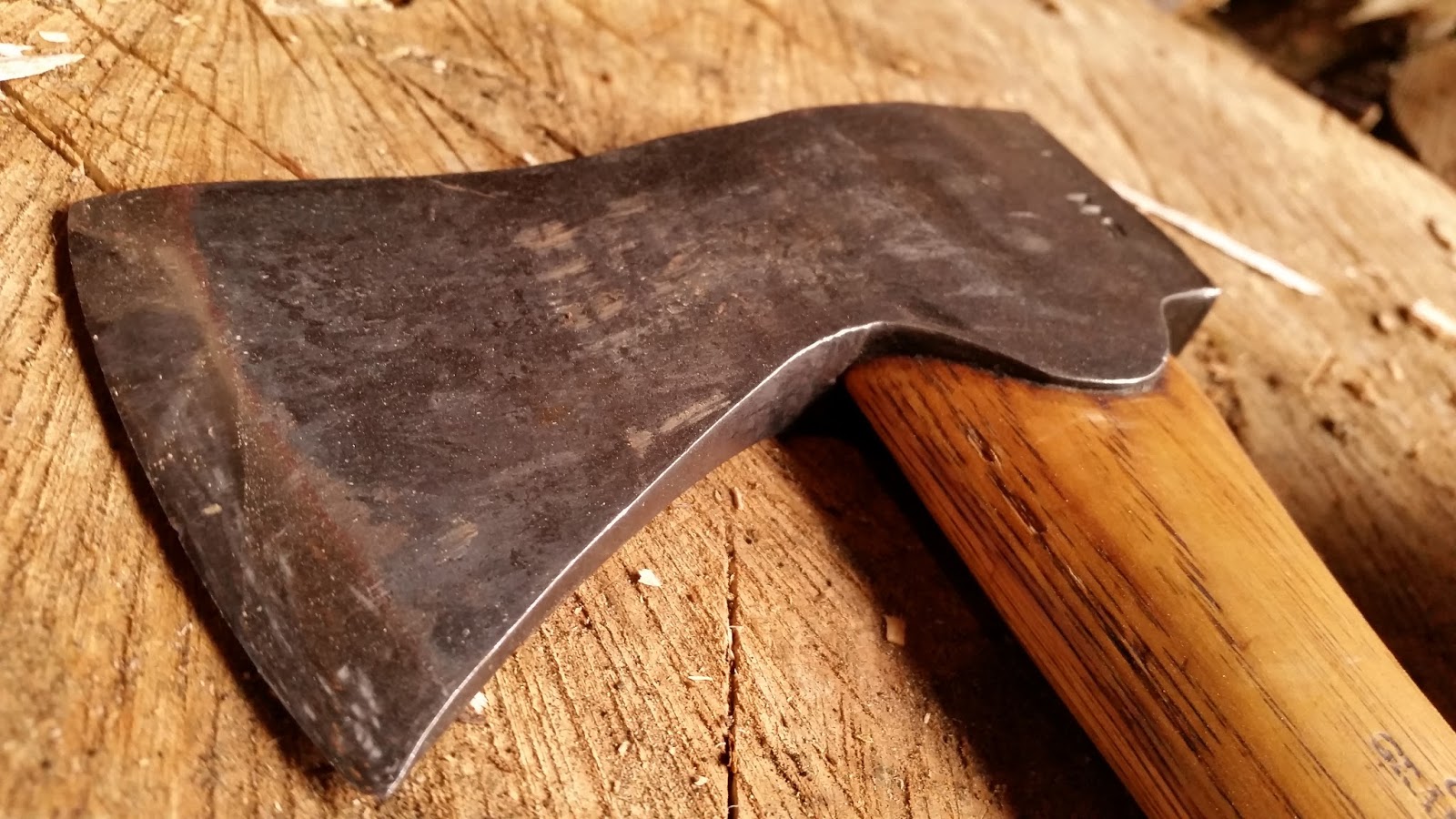
My pride and joy
We carry out annual tree surveys which flag up trees that could possibly be dangerous to the public. The reasons can vary, but usually it is down to the tree being detrimental to the public’s safety, thanks to a heavy lean or rot at the base of the tree. 

Once we have found our tree we would identify the best direction of fall depending on the lean of the tree, the crown’s distribution and neighbouring trees. Then we would clear the immediate area of shrubs and low-lying branches, anything that could get in the way of your escape route. Eventually when the ranger is happy with the situation, he will fell the tree whilst us volunteers stand very, very, very far way and ensure the public do not interfere.

If you want to know how we process our  timber from start to finish, please follow this link to our blog video on YouTube: The video


The  Reasoning Behind it All

Seasoned firewood ready to burn
So why go through so much trouble to find a suitable fuel for heating?

 Well there are certainly a few factors to consider.

Wood fuel that is derived from a sustainable source is virtually carbon neutral. This means that the volume of carbon dioxide that is released during the pyrolisation of the wood, is the same volume that was taken up during the gasses in the atmosphere.

The face of tyranny
In the grand scheme of things, the wood we burn here is essentially carbon neutral, save the emissions given off by a chainsaw and a tractor's engine. Most of the legwork is done by hand (sounds odd?) with muscle power (volunteers) doing most of the work.

Many of the trees that are taken out also contribute to the overall management plan of the reserve. A prime example being the felling and clearing of young Silver Birch ( Betulina pendula). These are a pioneering species, meaning that they will encroach upon a wide variety of terrain and colonise in large numbers. The seeds germinate relatively quickly and then shoots vigorously, in our native climate the grassland can be littered with healthy saplings within a few years.

This, from the perspective of species rich grassland, can spell disaster. Therefore in order to conserve the said grassland the birch trees are cut on a regular basis, within the cutting season of course. The wood itself  also makes respectable fuel, burning fiercely but quickly. In summary, the management of tree species such as the birch is both a benefit for us volunteers and the continuing conservation efforts in Murlough.


A change of hands


Welcome to Murlough's Volunteer Blog!

With a new wave of volunteers comes a new wave of blogs, which if we are persistent will be available for your reading pleasure on a monthly basis.

So without further ado we will introduce ourselves:

Rich


My name is Richard Dear, I'm 21 and I'm currently studying at UWE (University of the West of England) in Bristol.I'm enrolled on the BSc Conservation Biology course for a four year period, and I'm currently in my third year doing a 40 week placement with the National Trust here at Murlough.

I've always loved being in the great outdoors. Never satisfied with the idea of an office job but striving for a hard working,honest  job surrounded by woodland. This is probably why I have developed a fervent commitment to Bushcraft, a pursuit of which I have begun to teach with the British Bushcraft School and at public state schools with young ones.

I  guess I had chosen to volunteer here because I want to land a job as ranger, and what better way to learn than to be working day in day out beside three of them. I was dubious about coming over at first and dedicating an entire year of my existence to the trust, but boy was I wrong.

Living in the volunteer accommodation is a perfect set up. Seeing as it is directly above the offices and slap bang beside our work place (meaning more sleep!) and the rooms are pretty cosy at night when the weather is pitted against you.

I simply wouldn't be able to describe the joy of working here in a single blog, so I'll cherry pick. My favourite thing about working here? The variety. Every day is different, we could be processing firewood (I love swinging axes...) one day and then scanning the reserve for Marsh Fritillary Larvae the next.

Graham


My name is Graham Drew, I'm 22 years old, and I'm currently on my 44 week placement here at Murlough National Nature Reserve. At present, I'm on a four year BSc Wildlife Conservation with Natural Resource Management degree, studying at Harper Adams University. 

Translocated from a small farming town in South Africa, I've always had the privilege of growing up amongst wildlife, inspiring my passion for conservation and working with wildlife, you could say that it's been ingrained into my skin. 

I've never been the type of person to sit in an office, so as a consequence of that, has lead me to various different jobs such as freelancing as sound engineer to working with a fireworks company (UK Fireworks). So when I heard of the opportunity to go and work in another country, it spurred me on to pursue. You could if you want, call it a "calling". 

I live within the volunteer accommodation accompanied with Rich (above). It's definitely a good hard graft over the months to keep the house warm. However, nonetheless like Rich said perfect. It keeps warm and dry during the cold harsh winter weather. 

Picking an activity to say which is the best and which is the worst is rather futile, since every task and activity has it's benefits and cons. However, if having to choose one as a must, it'd most likely have to be the scrub clearance and burning. Such an activity seems to bring forth a sense of satisfaction and gratification, knowing what you're doing and that it has a potential benefit to the landscape really seems to bring that forth. 


James


My name is James Clarke and I am 20 years old. I am currently studying Environmental Biology at Queen's University Belfast and I am volunteering at Murlough as part of my placement year. I will be volunteering here from the start of November 2015 until the end of June 2016.

I have lived in Northern Ireland all of my life and I am currently living in Dromore, Co. Down. I travel into Murlough every morning from home. I luckily have grown up around wildlife and always have had a passion for being outdoors (and in N. Ireland that involves all types of weather). Murlough was a draw to me for the reason that I would be able to work outdoors in one of the most important areas for wildlife in Northern Ireland.

In my free time I enjoy playing acoustic guitar and have been lucky enough to achieve a grade 8 with this instrument. I have also played squash from a very young age and still get in a few games a week.

I am looking forward to the rest of my time here at Murlough and hope to acquire new skills and knowledge that will help wherever my future takes me.


Friday, 27 February 2015

Clearing European Gorse

Burning European Gorse

European Gorse, also called Ulex europaeus, is a fast growing plant and can grow to a height of 3m. In spring and summer you will see its yellow flowers. The leaves are like thorns and form their defense mechanism.

Ulexeuropaeus (European Gorse)

The pointed leaves of the Gorse The yellow flowers of the Gorse

Because the plant is so resistant and grows so fast, it is very invasive. Everywhere you go, you’ll see Gorse. The result: European Gorse has invaded areas where lowland heath could expand into. But there are also good points about Gorse. It is a good nectar source and area for bird nesting. So National trust decided to remove some of the Gorse. They want to reduce the gorse cover down to 10-15%. This work is a challenge and will never be completed. As once they get to the acceptable level of cover, after that they have to prevent the spread.
Here is how we work. We cut the bushes with a brushcutter, bowsaws, loppers and chainsaws. After that we collect the Gorse and place it in a pile.


Collecting Gorse

Putting the Gorse on a pile

When we have reached a big pile of Gorse, we burn it. We must be careful with this, because we want to keep a controlled fire.


Putting Gorse on the fire

If your cutting the Gorse it’s important to treat the stumps with chemically to prevent re-growth.
We still have to work several weeks to finish the burning. It’s also important to stop this work in the period between 1 March and 31 august to avoid disturbance to nesting birds.

Wednesday, 20 November 2013

Regeneration of Burn Site Vegetation

In the Ring Reserve at Murlough NNR there were 4 illegal fires that occurred at the start of summer. The burn sites were then surveyed in order to monitor effects of the fires and the regeneration of the vegetation on the 4 sites.

In order to monitor density and height of different regenerated plant species, a number of fixed quadrats were placed on each of the burn sites. Fixed point photography was another method used to monitor regeneration of plant growth. See below example of fixed point photography at Site A:

Site A: 13th August 2013

Site A: 23rd September 2013

Although plant density and height were monitored the regeneration of vegetation may have been affected by the severity of the burn which was noted before monitoring took place.

A map was then created using a GPS mapping system which marked the location and size of each of the burn sites in the Ring Reserve. The fixed point photography points were also marked on the maps.

The main plant species monitored included bracken, marram grass, carex, rose bay willow herb and burnet rose. These plant species seemed to regenerate rapidly over the summer months with growth slowing at the start of October. The regeneration growth of bracken, burnet rose, marram grass and carex however were affected by the grazing of rabbits.

The data collected in relation to height and density of different plant species will then be visually represented on graphs making the data easily compared and interpreted. The regeneration of burn site vegetation study may come in useful in relation to the long term strategy of Murlough NNR.

This survey has allowed me and other volunteers to get involved and gain experience in vegetation surveying with the help of experienced botanist Professor Matt Dring. This survey is also being used for my university project that I have to complete during my placement year.  

By Rebekah Stevenson

Volunteer Profile

Hello, my name is Rebekah Stevenson and I am studying BSc Hons Countryside and Environmental Management at Harper Adams University. I currently am on my placement year and have been a volunteer assistant ranger at Murlough NNR for nearly 5 months.

Since being at Murlough I have gained experience in strimming, brushcutting, habitat management, general site management, fencing, boardwalk repairs, tool maintenance and a variety of surveys including butterfly transects, vegetation surveys, seals and bird counts. I have also been involved in ‘Wild Child’ a summer scheme which allowed me to work with the general public and passed my Safe Tractor Driving Course.

This placement has allowed me to gain confidence in my own abilities and gain valuable practical experience in a variety of tasks. Working at Murlough is hard work but the team is supportive and the work is rewarding. 

In the future I would like to be involved in countryside education or become a countryside officer for a large conservation organisation or government department. Although, I would love to volunteer for conservation projects abroad at some point as well.


Wednesday, 16 October 2013

Pumpkinfest

This weekend was the annual Pumpkinfest at Castle Ward. The festival had many activities and stalls, and the Murlough staff were invited down to help with the pumpkin carving and the scarecrow treasure trial.   

The scarecrow trail was a huge success, with our volunteers taking turns to man the start and finish. The children got their maps at the start, then had a great time with their parents following the map around the grounds looking for the scarecrows, and answering questions on them. Though a few did get lost, eventually everyone did find their way down to the courtyard were another of our volunteers was waiting for them with a little prize.

The pumpkin carving was a huge undertaking at the festival. Each participant chose their pumpkin at the start, then took them to have the top cut off before scooping out the insides themselves. Each child or adult then drew up their own design on the pumpkin, before taking it to be cut out by one of the volunteer pumpkin carvers. If we were not professional pumpkin carvers before, we were 2800 pumpkins later, and with cuts and blisters to prove it!   

Wednesday, 18 September 2013

Marsh Fritillary Web Counts

At this time of the year, if you look really closely, you may be able to spot our Marsh Fritillary butterfly webs. The Marsh Fritillary is a protected species, and is a priority species on the UK BAP(Biodiversity Action Plan). It is extinct in many countries, and in decline in others, with the UK being the last strong hold of them.

The Marsh Fritillary lay their lava under the leaves of their food plant devils bit scabious from May-June. They hatch from June onwards, and live in communal groups in webs. These webs become more obvious towards the end of August. In Autumn they will make stronger webs closer to the ground where they will hibernate, then will disperse in the spring. 

As the more obvious webs are around at this time of year we use these webs to measure the breeding success of our Marsh Fritillary. This is important as they are a protected species. Each year we conduct a count on the main patches of devils bit scabious. For the last few years we have also done surveys on the scrub in these areas so we can assess what management is needed to help increase their numbers. This means estimating at each of our mapped out plots how much of each of the scrub species (gorse, bramble, burnet rose, ragwort and others), as well as an overall scrub cover of the area, and bracken estimated separately. This can tell us what sort of composition of scrub the Marsh Fritillary favours.